You're using an "Internet Explorer" web browser that's no longer supported.
This website will not function correctly when using when using Internet Explorer,
so please upgrade to a modern web browser, like Edge, Chrome, or Firefox.
By Seth Berman, Mariano Martinez Peck, Johan Brichau, and Esteban Maringolo
Artificial intelligence has quickly become part of nearly every software development conversation. Today's development tools promise AI-powered coding, automated software generation, and dramatically faster development. Those are worthwhile advancements, but they weren't the problem we set out to solve.
At Instantiations, we asked a different question:
What if AI could participate in the development process itself?
Not as a replacement for experienced developers. Not as another chat window disconnected from the work. But as a development partner that understands the application, helps investigate complex systems, accelerates repetitive tasks, and allows developers to spend more time applying the judgment and experience that only people can provide.
That question becomes even more important when you're working with enterprise software. These applications aren't simply millions of lines of source code. They're decades of business knowledge, architectural decisions, customer requirements, operational experience, and lessons learned through years of production use. You can't responsibly evolve systems like these by asking AI to generate more code. The result isn't simply writing code faster. It's giving developers the context they need to solve problems more effectively.
That philosophy became the foundation for the VAST AI Assistant.
We built a development companion designed to work alongside developers inside VAST's live environment. It helps developers investigate problems, navigate large codebases, generate focused tests, and move from understanding to implementation without losing context or control.
Today, our own engineering team relies on the Assistant every day while building VAST itself. We asked four members of the team to share how AI has changed the way they work, what surprised them most, and why they believe the future isn't AI replacing developers, it's AI helping experienced developers accomplish more than ever before.
The Philosophy Behind AI in VAST
For Seth Berman, CEO of Instantiations, the motivation wasn't simply adding AI because the industry expected it.
"We saw that AI could become much more valuable when it was connected directly to the development environment rather than used as a separate chat tool."
VAST has always been different from traditional development environments. Developers work with a live application, inspecting objects, debugging running processes, exploring runtime behavior, and evolving software while it's executing.
Rather than forcing developers to leave that environment for an external chatbot, the goal became integrating AI directly into the workflow they already knew.
Mariano Martinez Peck explains why that distinction matters.
"General AI tools treat code as static, file-based text. That falls short for Smalltalk. We wanted an AI that could work directly inside our dynamic, live programming environment."
Responsible AI is about giving experienced developers better tools to evolve complex software.
AI as a Developer Partner
Every engineer we spoke with described the AI Assistant differently. But none described it as "just a code generator."
For Johan Brichau, it's become his everyday pair programming partner.
"Rapid prototyping with the AI tool is my default practice. I explain the problem just as I would to another developer, review its suggestions, and iterate toward the final solution."
Esteban Maringolo says the Assistant has fundamentally changed how he approaches development.
"It's my daily driver. Most of my tasks start and end in the Assistant."
Instead of manually searching documentation, copying code between tools, or writing repetitive tests, he begins by asking the Assistant to gather context. That allows him to focus on solving the actual problem.
Seth Berman has adopted a different workflow.
Rather than asking AI for answers, he uses it to challenge his own thinking.
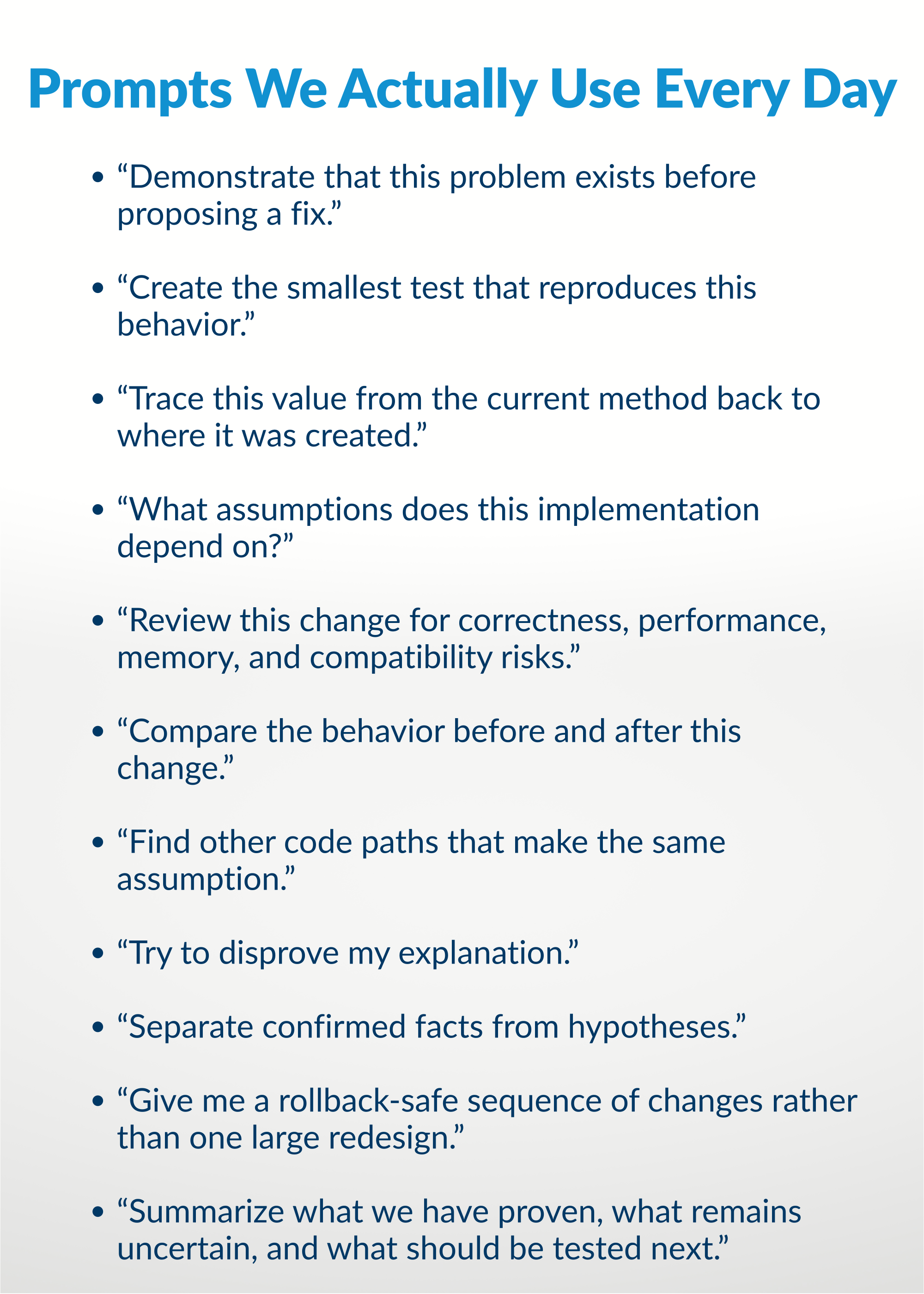
"One of my most useful prompts is simply: 'Here is what I think is happening. Try to prove me wrong.'"
That investigative mindset has become central to how the team uses AI.
Developers ask it to:
Trace execution across large codebases
Generate focused tests and benchmarks
Review proposed changes
Summarize investigations
Explain unfamiliar code
Analyze debugger output and log files
The result isn't simply faster code generation. It's faster investigation, deeper understanding, and more informed engineering decisions.
Building the AI Assistant with AI
Perhaps the strongest endorsement of the VAST AI Assistant comes from the fact that it helped build itself.
While developing the Assistant's merge browser and code diff capabilities, Johan relied heavily on AI while integrating the Scintilla text editor.
"The documentation was limited. The AI already understood many implementation details and helped us reach a working solution much faster than I could have on my own."
Mariano describes another example.
"We used the AI Assistant while building the Assistant itself to prototype our custom rendering engine, merge views, and diff algorithms."
The team has also used the Assistant while investigating difficult Virtual Machine issues and improving Unicode performance throughout VAST.
In one recent performance investigation, the Assistant helped engineers move between Smalltalk code, runtime behavior, VM implementation, benchmarks, and testing within a single investigation.
Instead of replacing the investigation, it accelerated it.
As Seth explains,
"The strongest moments weren't when the AI generated code. They were when it helped turn an unclear problem into a testable explanation."
AI Should Enhance, Not Replace, Developer Expertise
One message was clear for the engineering team.
The better AI becomes...
...the more valuable developer judgment becomes.
Esteban sees developers becoming curators of AI-generated work.
"The knowledge of what to add and the personal taste become more valuable than before. We become architects, product owners, and curators of what the AI produces."
Mariano agrees.
"The assistant proposes code, but developers review, validate, and apply every single change."
Seth explains why that matters for enterprise software.
"Mature software contains customer history, architectural compromises, business assumptions, and lessons learned from years of production use. AI can generate possibilities. Developers determine whether those possibilities are actually correct."
That philosophy is particularly important for organizations maintaining applications that have evolved over decades.
AI can dramatically reduce the cost of investigation. It cannot replace experience.
The future isn't AI instead of developers. It's AI multiplying what experienced developers can accomplish.
Open Source and Community-Driven Innovation
The VAST AI Assistant is open source because we believe the best developer tools improve through real-world use.
Many of today's capabilities weren't created from a product roadmap. They emerged because our own engineering team needed them while evolving VAST itself.
Debugger integration.
Merge workflows.
Test generation.
Context-aware investigation.
Interactive navigation.
Every feature grew from developers solving real problems.
Making the Assistant open source reflects the same philosophy behind our Responsible Evolution practice. We believe developer tools improve through collaboration, transparency, and real-world use. By inviting the community to contribute, we're not only improving the Assistant itself, we're helping shape how AI-assisted development evolves within the VAST ecosystem.
As more developers adopt the Assistant and contribute feedback, that cycle continues. The community doesn't just use the project. It helps shape it.
Looking Ahead
The team sees AI becoming more deeply integrated into the live development experience.
Mariano is excited about allowing AI to inspect live objects and navigate object memory.
Johan wants tighter integration with autocomplete and the Smalltalk development tools developers already know.
Seth sees the Assistant becoming even more evidence-driven, helping developers investigate problems, gather supporting information, propose safe changes, and preserve the reasoning behind every decision.
Despite those advances, one thing won't change. Developers remain responsible for the outcome. That's exactly how we think AI should evolve.
Looking at the long-term trajectory of the industry, Esteban points out:
"What we call 'AI-driven development' today will eventually just be 'development,' in the same way 'modern medicine' simply became 'medicine.'
Get Started
If you're already developing with VAST, try using the AI Assistant on your next investigation. Ask it to explain an unfamiliar subsystem, generate a focused unit test, review a proposed change, or help trace a difficult bug. You'll quickly discover that its greatest value isn't writing code. It's accelerating understanding.
If you're an object-oriented developer outside the VAST community, we invite you to explore the open source project on GitHub and see how we're approaching AI differently. Rather than bolting AI onto an editor, we're integrating it directly into a mature live development environment where developers remain firmly in control.
The future of enterprise software isn't about replacing developer expertise. It's about giving experienced developers better tools to understand, maintain, and evolve the systems organizations depend on every day.